The firm's models remain yours
Each model built by the firm goes into your library, with its author and its uses.
Breakfast on November 27 in Paris: is your value chain ready for the next crises? Learn more

LCA expert and R&D collaboration
Your expert builds the blocks and keeps control of the method. Your engineers call them in their products and see the impact of their choices.
They trust us


















Two professions, one model
An LCA requires two professions that often work separately: the LCA expert, who knows how to calculate impact, and R&D, who knows the product. Sapiologie is collaborative LCA software that has them work on the same model, each in their own words.
LCA expert
Elementary blocks
It models your steel grade, your electricity mix, your specific processes.
Datasets and allocations
It chooses the datasets and sets the method and allocations.
Sourced assumptions
It documents each assumption on the data, with its source.
Approved links
It approves the links made by the engineers.
R&D
BOM and processes
The engineer enters the inventory with what they know about the product: BOM, processes, suppliers, sites.
Called blocks
It calls the expert's blocks without having to choose between two datasets.
Inventory without waiting
It describes the product while the expert chooses their datasets; each flow is then linked to a block.
Tested variants
It tests its ecodesign options in its copy of the organization.R&D mode
Learn more
A byproduct is a full LCA in its own right: calling it as an input grafts its whole branch into another product. The link stays dynamic, so a change of material or supplier on a component carries over to every product that uses it.
Roles and rights
An administrator creates accounts, assigns roles and opens each application to the team that needs it. Roles are set application by application: a team can open one application without the others.
| What the role allows | Editor | Analyst | Collector | Reader |
|---|---|---|---|---|
| The four roles | ||||
| View the inventory | Yes | Yes | Yes | Yes |
| View impacts and analysis pages | Yes | Yes | Yes | Yes |
| Comment | Yes | Yes | Yes | Yes |
| Open an alternative organization (R&D mode) | Yes | Yes | Yes | Yes |
| Three roles | ||||
| View the modeling, including the model library | Yes | Yes | No | Yes |
| Vary the variables and see the recalculation | Yes | Yes | Yes | No |
| Two roles | ||||
| Run or rerun the LCA calculation | Yes | Yes | No | No |
| Edit analysis pages | Yes | Yes | No | No |
| Edit the inventory, including usage and distribution scenarios | Yes | No | Yes | No |
| The editor alone | ||||
| Edit the modeling, including the library and end-of-life scenarios | Yes | No | No | No |
| Create an alternative organization | Yes | No | No | No |
Learn more
Single sign-on (SSO) can be configured for organizations that require it. Each user enables two-factor authentication in their settings. The audit log lists each user's actions and the login history.
Data collection
Questions are asked on the data itself and the answers stay there, including between a firm and its client. The collector answers in the tree, without touching the expert's modeling.
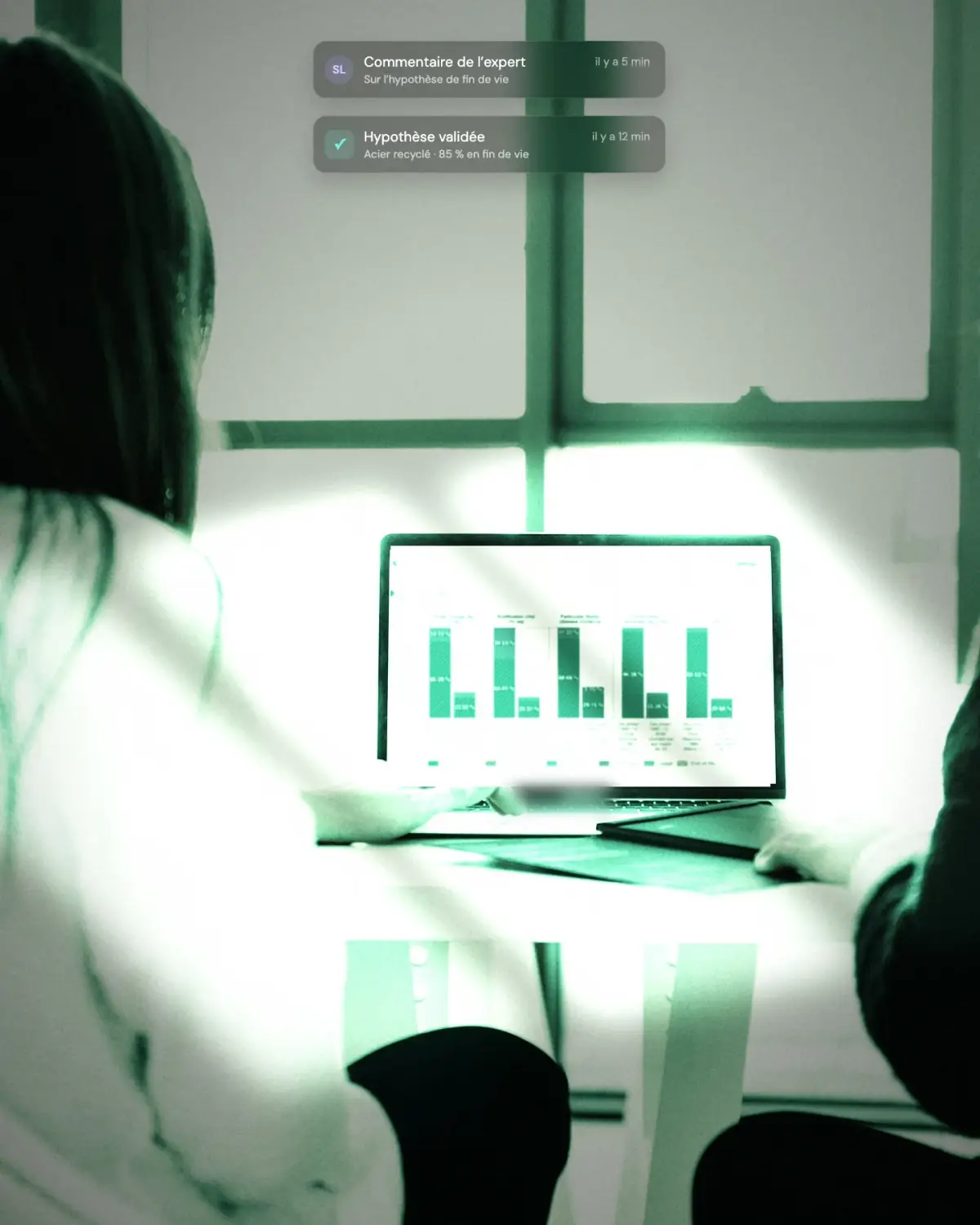
You ask a question anywhere in the inventory, down to a loss rate or a quantity, and you mention the colleague who holds the information. They find it in their notifications.
A comment becomes an assigned task, with its due date. It appears on the person's home page, and one click takes them to the field to fill in.
A comment becomes an assumption attached to the data, with its source. It is found everywhere the data is used.
Learn more
The process tree outlines each incomplete item in red and turns it green once the data is entered. The calculation runs despite missing data; the result is then partial.
Working with external consultants
The firm works with the same tool as you, in your workspace, and what it produces stays with you.
Same tool, same workspace
The firm joins your workspace with the same tool as you, without switching software.
What it produces stays with you
Models and inventories stay in your workspace; changing firms does not lose the work already paid for.
Your teams in the loop
The firm invites your colleagues as collectors or readers; your engineers collect data, the firm guides and verifies.
The verifier inside the model
It checks methods, data and assumptions on screen, instead of rereading a frozen report.
Each model built by the firm goes into your library, with its author and its uses.
The supplier answers your requests, the customer receives the impact sheet, the verifier comments and asks for evidence.
Learn more
The firm keeps its own library. When a model is created in your workspace, a checkbox deposits a copy with the firm: an energy mix, a transport, a steel grade. Your BOM never leaves your workspace.
Traceability
The audit log covers the whole application. A study is reread on live data, with its history.
Learn more
Sapiologie logs data, assumptions and versions. The expert writes the report, the verifier conducts the critical review according to ISO 14071:2024, and compliance with ISO 14040:2006 and ISO 14044:2006 applies to the analysis.
They use it
Radiall
“We were looking for a tool where LCA experts and product designers with no LCA training could easily work together. The product designers chose Sapiologie because it is intuitive, the LCA experts for its power and flexibility.”
 Connectors, aerospace and space
Coming soon
Invite a consultant yourself
The administrator adds an external consultant or verifier from user management.
Email notifications
Mentions, replies and tasks also arrive in your mailbox.
Critical review in the tool
The verifier approves the study in Sapiologie, and the modeling is frozen after the review.
Rights by team
Data visible only to a team, a division or a product category.
Sapiologie
In the demo, the expert models a block, an engineer calls it in their product and the verifier checks the model in the tool, on a standard case or on one of your products under a confidentiality agreement.
Request a demo with your teamFAQ
Your questions about collaboration between LCA expert and R&D.
See the release notesNo. The collector touches neither the modeling nor the model library. Each change is recorded in the audit log and can be undone.
The firm invites its clients as collectors or readers. A company that wants to model by itself opens its own workspace, where the firm is invited; it remains the owner.
Through two separate libraries, the firm's and the company's. A checkbox copies a model to the firm's library; the BOM never leaves the company's workspace.
Yes. The audit log shows who changed what and when, across the whole application, and each change can be undone.
Yes. They are invited to the workspace and check methods, data and assumptions on screen. ISO 14071:2024 sets the critical review process and the verifier's competencies.