May 22, 2024
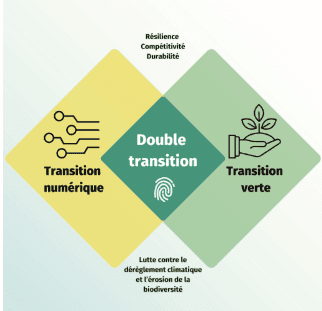
What is the twin transition?
The twin transition, or translated into French as the double transition, refers to the combination of the green transition and the digital transition. While the digital transition leverages technologies for sustainability, efficiency, and empowerment, the green transition focuses on combating climate change and environmental degradation (Muench et al., 2022). The interaction between these two transitions is crucial for co-evolution and creating synergies that enable the achievement of the goals of a sustainable society and a resilient and competitive economy.
The Digital Transition: A Contribution to a More Sustainable Future?
Digital technologies, such as real-time monitoring and processing of information, simulations and forecasts, and the virtualization of production and consumption, catalyze the green transition by optimizing resource use and helping to reduce environmental impact (Digital Europe, 2017; Muench et al., 2022). For example, digital twins allow for the simulation of the entire life cycle of a product or process, thereby promoting more sustainable practices. Data and data analysis are essential to the green and digital transition.
A Key Priority for the European Union
Under the presidency of Ursula von der Leyen, the twin transition has become a priority for the European Commission (European Commission, 2020), highlighted by the launch of the Industrial Strategy for Europe in 2020 (European Commission, n.d.). This strategy supports the ambitions of the European Green Deal, aiming notably to achieve net-zero greenhouse gas emissions by 2050 and to decouple economic growth from resource use (European Commission, 2019). As part of Europe’s Digital Decade, ambitious targets have been set: 75% of EU companies should utilize technologies such as cloud computing, artificial intelligence, or big data, and more than 90% of SMEs should reach a basic level of digital intensity (European Commission, n.d.).
What are the connections between Industry 5.0 and the twin transition?
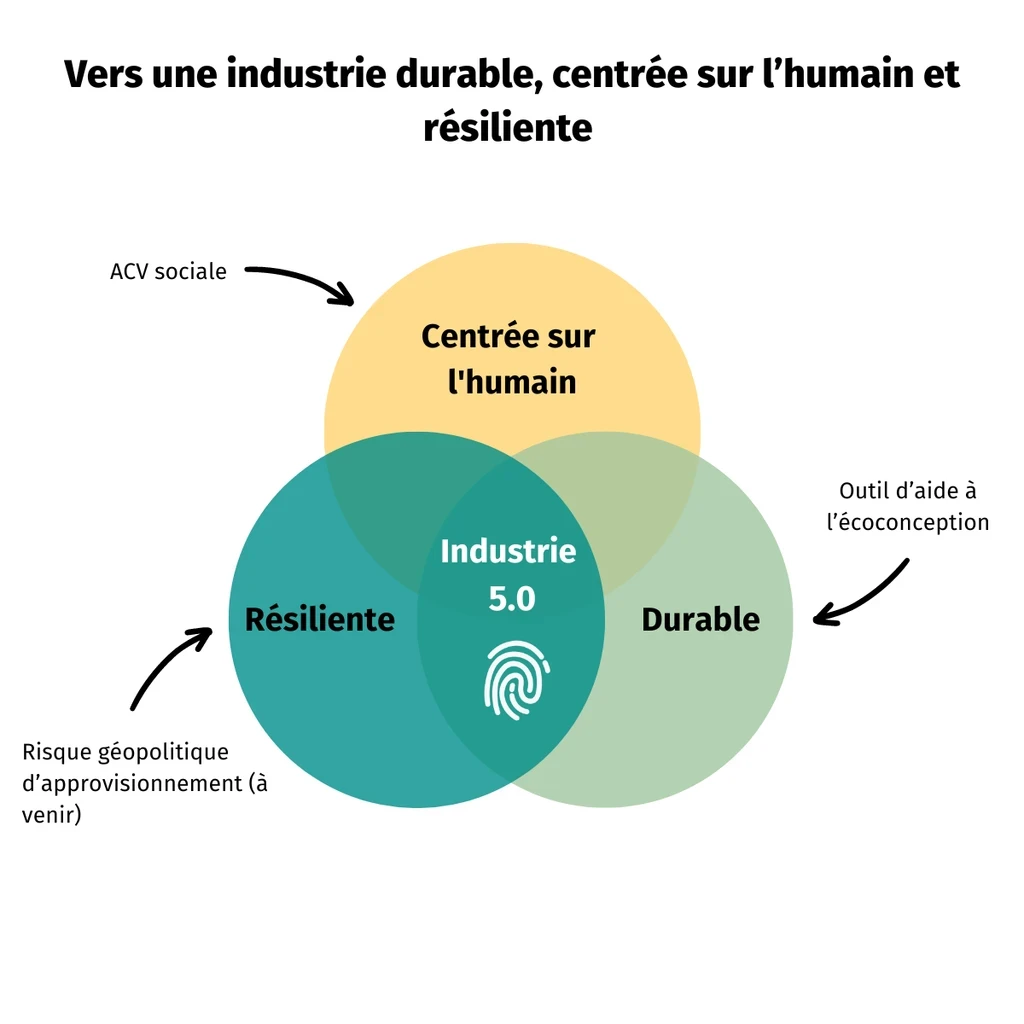
Industry 5.0 and the twin transition are concepts that intertwine to mutually reinforce technological, social, and environmental progress. For example, Industry 5.0 leverages the advancements of the digital transition to enhance production capabilities while integrating ecological principles from the green transition, such as energy efficiency and waste reduction, and vice versa. The twin transition can draw inspiration from the human-centered approach of Industry 5.0 (Sapiologie, 2024). Together, they create a sustainable industrial development model that combines technological efficiency with environmental respect.
Potentials and Limits of the Twin Transition
While the digital transition is largely driven by the private sector and is motivated by ongoing technological innovation, the green transition requires strong political and societal impetus to be realized (Muench et al., 2022). The challenges include managing environmental impacts, such as the manufacturing of electronic products and the resulting digital waste, as well as the impacts of digitization itself, including the demand for electricity to power devices and electronic equipment, and the high energy consumption of data centers used to store and process digital data (Bianchini et al., 2023). However, initiatives like the Climate Neutral Data Centre Pact show how the sector can self-regulate to mitigate these impacts.
The synergy between public policies and private sector initiatives is therefore essential for the twin transition to be both fair and effective.
References
Bianchini, S., Damioli, G., & Ghisetti, C. (2023). The environmental effects of the “twin” green and digital transition in European regions. Environmental and Resource Economics, 84(4), 877-918.
Digital Europe. (2017, October 27). Digital action = Climate action: 8 ideas to accelerate the twin transition.
https://www.digitaleurope.org/resources/digital-action-climate-action-8-ideas-to-accelerate-the-twin-transition/#ideas
European Commission. (2020). State of the Union 2020.
https://state-of-the-union.ec.europa.eu/state-union-2020_en
European Commission. (2019). Communication from the Commission: The European Green Deal. COM(2019) 640 final.
European Commission. (n.d.). European industrial strategy.
European Commission. (n.d.). Europe’s Digital Decade: digital targets for 2030.
Muench, S., Stoermer, E., Jensen, K., Asikainen, T., Salvi, M. and Scapolo, F. (2022). Towards a green and digital future. Publications Office of the European Union.
Sapiologie. (2024, April 29). Towards a sustainable, human-centered, and resilient industry.
For further reading:
Fouquet, R., & Hippe, R. (2022). Twin transitions of decarbonization and digitalization: A historical perspective on energy and information in European economies. Energy Research & Social Science, 91, 102736.
Request a demo
Latest articles
Mar 31, 2026
Read more
Dec 10, 2025
Read more
May 28, 2024
Read more