May 22, 2024
What is Industry 5.0?
Industry 5.0 aims to place human well-being at the center of manufacturing systems, thus allowing for the achievement of social goals beyond employment and growth to ensure sustainable prosperity for the sustainable development of all humanity (Leng et al., 2022).
The definition of Industry 5.0 proposed by the European Commission is as follows:
“Industry 5.0 recognizes the industry's ability to achieve societal objectives beyond employment and growth, so that it becomes a resilient provider of prosperity, ensuring that production respects the limits of our planet and placing the well-being of the industrial worker at the center of the production process.” (European Commission, 2021a).
What are the differences with Industry 4.0?
Industry 4.0 is primarily a techno-economic vision, indicating how technological advances, often generated in non-industrial contexts, will be utilized in industrial value chains and how they will influence the economic situation of the industry (European Commission, 2021a; European Commission, 2021b).
Industry 4.0 is characterized by technological advancements that have substantial positive impacts on profits but takes little or poor account of environmental and social aspects (Nara et al., 2021). Industry 4.0 is considered technology-driven, while Industry 5.0 is guided by values of sustainability (Xu et al., 2021).
The three main characteristics of Industry 5.0: human centrality, sustainability, and resilience.

Leng et al. (2022). The evolutionary history of Industry X.0. Reprinted from “Industry 5.0: Prospect and retrospect”. Journal of Manufacturing Systems 65, 279-295.
The vision of the European Union
Industry 5.0 contributes to three of the European Commission's priorities: “An economy that serves people,” “The European Green Deal,” and “A Europe fit for the digital age” (European Commission, n.d.).
Elements related to the future of industry are already part of the main political initiatives of the Commission:
Adopt a human-centered approach to digital technologies, including artificial intelligence (AI Regulation Proposal);
Improve skills and reskill European workers, particularly digital skills (Skills Agenda and Digital Education Action Plan);
Modern, resource-efficient, and sustainable industries, and transition to a circular economy (Green Deal);
A globally competitive industry, accelerating investment in research and innovation (Industrial Strategy).
The role of Sapiologie in responding to Industry 5.0
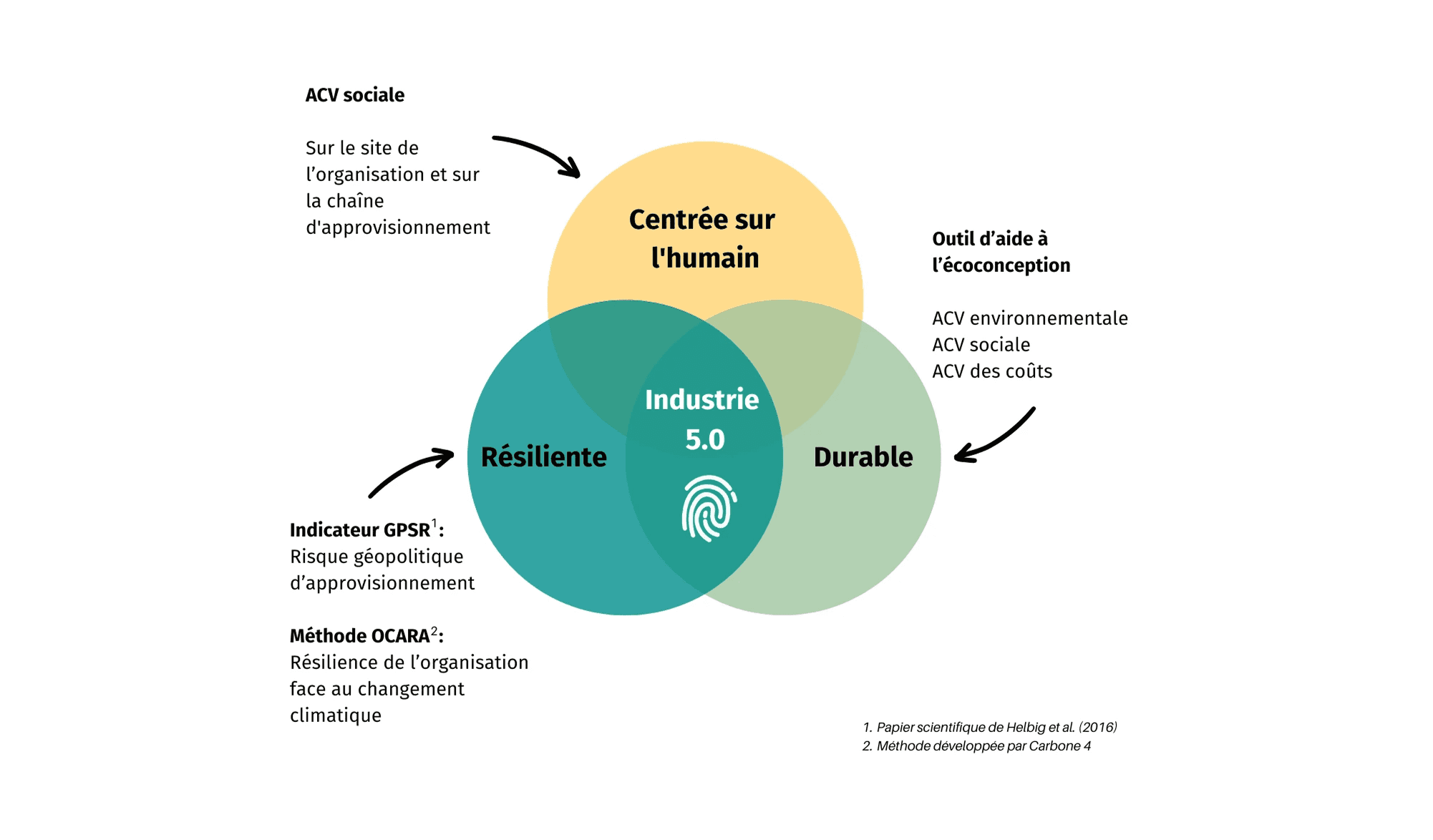
To align with the principles of Industry 5.0, Sapiologie has developed a digital twin solution, integrable with industrial companies' production management tools (ERP).
This solution allows for enhancing the performance of existing management tools, often focused on economic indicators, by integrating the three axes of Industry 5.0:
Sustainability: use of Environmental Life Cycle Assessment (LCA), social and cost (economic), as well as the Carbon Footprint.
Resilience: analysis of geopolitical supply risk (Helbig et al., 2016) and measurement of the organization's resilience to climate change (OCARA method, Carbone 4).
Human dimension: assessment of social impacts along the value chain through social LCA.
Moreover, Sapiologie contributes to the value chain-centered approach, an essential element for the transition to Industry 5.0 (European Commission, 2021b). Conducting comprehensive LCAs, which examine the entire supply chain, combined with an internal collaborative tool and with suppliers, helps to strengthen resilience throughout the value chain and facilitates long-term strategic planning.
References
European Commission, Directorate-General for Research and Innovation, Breque, M., De Nul, L., Petridis, A. (2021a). Industry 5.0: towards a sustainable, human-centric and resilient European industry, Publications Office of the European Union. https://data.europa.eu/doi/10.2777/308407
European Commission, Directorate-General for Research and Innovation, Renda, A., Schwaag Serger, S., Tataj, D. (2021b). Industry 5.0, a transformative vision for Europe: governing systemic transformations towards a sustainable industry, Publications Office of the European Union.
https://data.europa.eu/doi/10.2777/17322
European Commission. (n.d.). Industry 5.0.
https://research-and-innovation.ec.europa.eu/research-area/industrial-research-and-innovation/industry-50_en#latest
Helbig, C., Gemechu, E. D., Pillain, B., Young, S. B., Thorenz, A., Tuma, A., & Sonnemann, G. (2016). Extending the geopolitical supply risk indicator: Application of life cycle sustainability assessment to the petrochemical supply chain of polyacrylonitrile-based carbon fibers. Journal of Cleaner Production, 137, 1170-1178.
Leng, J., Sha, W., Wang, B., Zheng, P., Zhuang, C., Liu, Q., ... & Wang, L. (2022). Industry 5.0: Prospect and retrospect. Journal of Manufacturing Systems, 65, 279-295.
Nara, E. O. B., da Costa, M. B., Baierle, I. C., Schaefer, J. L., Benitez, G. B., do Santos, L. M. A. L., & Benitez, L. B. (2021). Expected impact of industry 4.0 technologies on sustainable development: A study in the context of Brazil's plastic industry. Sustainable Production and Consumption, 25, 102-122.
Xu, X., Lu, Y., Vogel-Heuser, B., & Wang, L. (2021). Industry 4.0 and Industry 5.0—Inception, conception and perception. Journal of manufacturing systems, 61, 530-535.
Request a demo